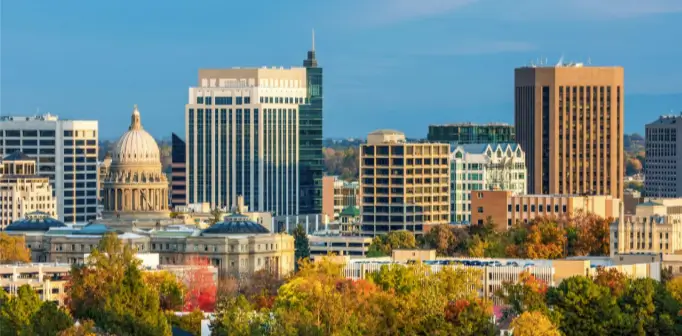
Every deposition is a logistics problem before it is a legal one. Someone has to reserve a room, confirm a reporter, arrange an interpreter, test the video feed, and get a certified transcript into the right hands before the next filing deadline. In Boise, those mechanics carry a few wrinkles that catch out-of-state counsel more often than they should. Understanding them is the difference between a proceeding that runs on rails and one that burns half a morning. It is also the reason NAEGELI Deposition & Trial has built its Boise operation around logistics as much as stenography.
What Out-of-State Counsel Should Know About Boise
Two Courthouses, Two Sets of Rules
Boise runs parallel court systems within walking distance of each other, and confusing them costs time.
State matters flow through the Ada County Courthouse, home to Idaho’s Fourth Judicial District. The district serves four counties of wildly different character, which matters more than the map suggests. Ada County alone was estimated at above 546,000 residents in 2025, making it the second most populous county in the interior Pacific Northwest behind Spokane County. Elmore, Boise, and Valley counties, by contrast, are mountainous and thinly settled. A single case can pull witnesses from a downtown high rise and a town three hours up a canyon road.
Federal matters go to the James A. McClure Federal Building and United States Courthouse at 550 W Fort Street, which houses the U.S. District Court for the District of Idaho along with the bankruptcy court and various federal agencies. Built in 1966 and renamed in 2001 for the late Senator James A. McClure, the seven-story building sits against the Boise foothills, with the courts occupying floors four through six. It was added to the National Register of Historic Places as a rare example of 1960s federal modernism in the state. Worth noting for planning purposes, the clerk’s intake counters keep shorter hours than the phones, generally 9:00 a.m. to 4:00 p.m. Mountain Time.
The Time Zone Trap
This one snares West Coast firms constantly. Boise observes Mountain Time, not Pacific. A 9:00 a.m. deposition in Boise starts at 8:00 a.m. for co-counsel in Portland, Seattle, or San Francisco, and a notice that fails to specify the zone invites a witness sitting alone in a conference room for an hour. Idaho is also split across two time zones, with the northern panhandle on Pacific Time, so even in-state coordination deserves a second look before the notice goes out.
Distance Is the Hidden Variable
Idaho is large, mountainous, and sparsely populated outside the Treasure Valley. Interstate 84 runs roughly 276 miles across the southern half of the state and does most of the heavy lifting, but the moment a route leaves the interstate it narrows into two-lane canyon roads with steep grades that take considerably longer than a navigation app estimates.
Winter compounds it. Traction laws and chain requirements apply on some mountain routes, rental agencies restrict certain vehicles during heavy snow, and seasonal closures can put a witness effectively out of reach for months. Any litigator scheduling a January deposition with a witness in Valley County should treat the drive as a genuine risk to the calendar rather than a formality.
Downtown Practicalities
Once you are in the core, Boise is easy. The state capitol, the federal courthouse, the county courthouse, and the bulk of the private bar sit within a compact and walkable downtown. Courthouse parking is inexpensive, with the first hour free and a nominal hourly rate after that. Boise Airport is about fifteen minutes out. For record retrieval, Idaho’s iCourt portal covers state court filings from 1995 forward, while anything older generally requires the clerk’s office directly.
How the Boise Office Manages the Record
Taking the record well means solving problems at three separate stages. NAEGELI has been doing this work since 1980, and the NAEGELI Deposition & Trial Boise office on West Bannock Street sits about five minutes from the Ada County Courthouse.
Before the Proceeding
Scheduling is where most depositions are quietly won or lost. Dedicated case managers handle booking and remain reachable 24 hours a day, which matters because the legal calendar changes without warning and an emergency hearing rarely announces itself politely. Coverage runs around the clock, including last-minute depositions that would otherwise go uncovered.
Preparation also means logistics that have to be locked in early. The Boise office maintains private conference rooms suited to depositions and arbitrations, so out-of-town teams are not scrambling for a neutral venue. Interpreters need lead time as well, and NAEGELI provides certified legal interpretation and document translation across more than 200 languages and dialects, American Sign Language included.
See also: Business Disputes Are Rising: Here’s Why Companies Need a Business Litigation Attorney
During the Proceeding
Certified court reporters cover depositions, arbitrations, hearings, and trials, capturing a verbatim record with expedited and same-day transcripts available when the schedule demands it. Daily copy is routine rather than a special request.
Videography runs alongside the stenographic record for good reason. A transcript tells you what a witness said, while video preserves the pauses, the hesitations, and the delivery that a page cannot carry. NAEGELI’s videographers work with professional equipment and a working knowledge of court procedure, and the resulting video is synced to the transcript with keyword search and exportable clips.
For witnesses scattered across Idaho’s geography, remote depositions solve the distance problem outright. Secure remote proceedings let counsel take expert or fact testimony from anywhere without a canyon drive or an overnight stay, and they can make testimony practical for witnesses who would find a conference room genuinely difficult.
After the Proceeding
The transcript is the beginning of the work, not the end. Every deposition includes a full Word-Index transcript, which pays for itself the first time you need to locate a specific line of testimony during motion practice. Transcript summaries condense lengthy records into organized digests with key testimony flagged, useful when the volume outpaces the reading time available.
Document handling covers copying and scanning, Bates stamping, high-speed digitizing, OCR processing, trial binder production, and secure destruction, all routed through secure repositories. Transcription turns hearings, meetings, voicemails, 911 calls, and other recordings into certified transcripts, each reviewed and verified before delivery.
When the case reaches a courtroom, the trial presentation team integrates documents, photographs, graphics, video, animation, and exhibits into a coherent presentation, with equipment configured to the specific proceeding. NAEGELI has supported thousands of attorneys nationwide from discovery through verdict and often through appeal.
Why Logistics Are Strategy
None of this is glamorous work, and that is rather the point. A missed time zone, an unbooked interpreter, or a transcript that arrives two days late does not just create inconvenience. It reshapes what a legal team can accomplish before a deadline. Handling those details properly is what lets the substantive work proceed uninterrupted.