By a commercial HVAC industry contributor.
Your building’s HVAC system is probably one of your biggest expenses, but the real costs are often hidden. According to the U.S. Energy Information Administration, commercial buildings in the U.S. spent a combined $141 billion on energy in one year. A large part of that money goes to heating and cooling. In office buildings, for example, space heating alone can use 30% of all energy.
This spending isn’t staying the same. The EIA also projects that energy use for air conditioning is expected to grow by 29% by 2050. Without a good plan, these costs will only go up. The difference between a system that just runs and one that runs well can mean thousands of dollars in wasted money. A planned approach to commercial hvac maintenance denver isn’t just about fixing broken parts. It’s about stopping energy waste and breakdowns before they happen. This changes how you think about money, it’s not just a reaction to a problem, but an investment to prevent future ones.
Quick answer: A complete HVAC maintenance plan is more than just changing filters. It focuses on making the system run its best to control energy costs, make equipment last longer, and prevent major breakdowns. The key is knowing how to judge a service agreement on the work they promise to do, not just the price.
What’s inside
- What is the real goal of a maintenance plan?
- How can you evaluate a service agreement?
- What specific tasks should be on a seasonal checklist?
- Frequently Asked Questions
What is the real goal of a maintenance plan?
The main goal is to change your HVAC system from an unpredictable expense into a well-managed part of your building. It’s about controlling future costs, not just reacting to problems today. A system can be “running” but still waste a lot of energy because it’s not performing well. The goal is to close the gap between just working and working efficiently.
This means you have to get out of the cycle of waiting for things to break before you fix them. The equipment in most commercial buildings is very similar. The U.S. Energy Information Administration says packaged air conditioners are the most common cooling equipment, found in 52% of U.S. office buildings. The same data shows packaged heating units are the most common heating source, used in 43% of those buildings. These systems are popular for a reason, but they also have common problems that regular maintenance can prevent.
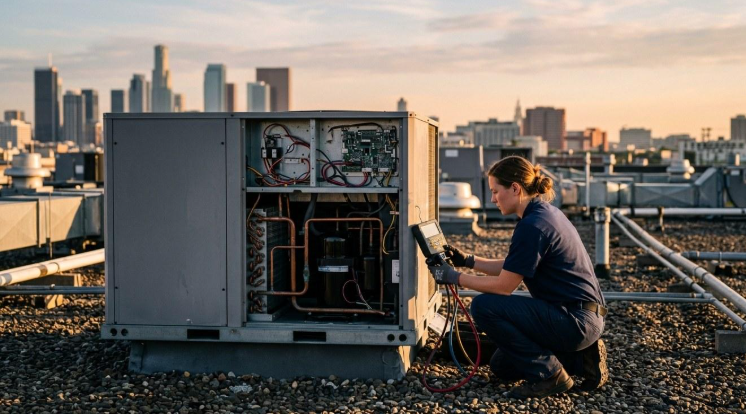
For example, a dirty condenser coil on a rooftop unit is a common problem that hurts performance. Dirt and grime act like a blanket, making the compressor work much harder to get rid of heat. This not only uses more electricity but also puts a lot of stress on the system’s most expensive part. A technician’s report should show regular coil cleaning, refrigerant pressure checks, and fan motor power usage. These are early warning signs of the system’s health.
❝ A good rule of thumb for budgeting: It’s often cheaper to save 10% on your energy bill through good maintenance than it is to negotiate a 1% price cut from your utility company. The savings are already there to be found.
In the end, a maintenance agreement is a business plan for your HVAC. It gives you the data needed to make smart repair-versus-replace decisions. It helps you manage big expenses by making equipment last longer and preventing surprise breakdowns that bother tenants and stop work. The goal is not just to keep the system on, but to control the cost of keeping it on.
How can you evaluate a service agreement?
You should judge an agreement by looking closely at the services they provide and the skills of their technicians, not just the price. A cheap plan that only does basic checks can make you think everything is fine while bigger problems are getting worse. The goal is to find a plan that focuses on measuring performance and using data to make decisions.
Many agreements look the same on paper. They list tasks like “change filters,” “inspect belts,” and “clean coils.” But the real value is in the data they collect during the service. A good technician doesn’t just look; they measure. They should be recording key information like:
- Air pressure in the system
- Temperature changes across coils
- Refrigerant pressures
- Power usage of fan and compressor motors
This data gives you a starting point to understand your system’s health. When you track it over time, it shows when performance is getting worse, long before a part breaks. This lets you plan for repairs instead of making emergency calls.
The quality of this data depends on the technician. Ask potential companies about their team’s training. A key credential to look for is certification from North American Technician Excellence (NATE). As the Air Conditioning Contractors of America (ACCA) notes, NATE certification is the industry standard for proving a technician’s real-world knowledge. A provider that invests in this training is showing they are committed to high-quality work.
| Feature | Basic “Checklist” Agreement | Comprehensive Performance Agreement |
| Task Focus | Visual check, filter changes. | Measurement and data logging. |
| Reporting | A simple checklist marked “done.” | Detailed reports with trend data and photos. |
| Technician Skill | Unspecified or entry-level. | Often NATE-certified or equivalent. |
| Strategic Value | Low; mostly reactive. | High; helps you plan for big expenses. |
❝ A service report without numbers is just an invoice. The most valuable part of any maintenance visit is the data that tells you how your system is performing over time. If you aren’t getting trend lines, you’re not getting the full picture.
To get past the sales pitch, ask these specific questions:
- “Can I see a sample service report for a building like mine?” A short, vague checklist is a red flag. A professional report will be detailed, with specific measurements and clear recommendations.
- “How do you track refrigerant use and disposal?” This is an important EPA rule you have to follow. A good company will have a strict, written process.
- “What is your process for recommending repairs versus replacement?” The answer should be based on data: efficiency loss, repair history, and how much you’ll save, not just how old the unit is.
A good agreement is a partnership built on clear data. It gives you the information you need to manage costs and plan for the future, turning your HVAC system into something you can manage, not an unpredictable problem.
What specific tasks should be on a seasonal checklist?
A seasonal checklist should focus on getting the system ready for the hard work it’s about to do. It is not just a list of parts to check. It is a test to make sure the equipment can handle the extreme heat of summer or cold of winter safely and without wasting energy. The tasks for cooling season are very different from the tasks for heating season.
For spring cooling startup, the focus is on getting rid of heat and controlling moisture.
- Condenser and Evaporator Coil Cleaning: Dirty coils are the main cause of poor performance. A technician should not just rinse them but use a special coil cleaner to remove dirt that acts like a blanket, forcing the compressor to work harder.
- Condensate Drain Clearing: The system will make gallons of water on a humid day. A clogged drain line can cause serious water damage in your building. The line should be flushed out to make sure it’s clear.
- Economizer Function Test: An economizer saves energy by using cool outside air instead of the air conditioner. If it is stuck open on a hot day, it forces the system to cool hot, humid air, which wastes a huge amount of energy. The technician must check that the dampers and sensors are working right.
For fall heating startup, the focus changes to fire safety and making sure it runs reliably in the cold.
- Heat Exchanger Inspection: On gas units, the heat exchanger must be checked for cracks or rust. A cracked heat exchanger can leak deadly carbon monoxide into your building’s air.
- Ignition and Burner Assembly Cleaning: Soot and dirt can block the pilot or ignitor. This can lead to a “no-heat” call on the first cold day. Cleaning the parts makes sure it starts up reliably.
- Crankcase Heater Check (for Heat Pumps): A crankcase heater is a small heater that warms the compressor’s oil in cold weather. This stops refrigerant from mixing with the oil. If that happens, it can destroy the compressor when it starts up.
❝ Ask a potential company how they check the economizer. A simple visual check is not enough. They should be able to describe how they test the motor and fake different outside air temperatures to make sure its computer brain is working right. This one part, when it’s not working, can be one of the biggest hidden energy wasters in a commercial building.
A good seasonal checklist is proactive. It deals with the most common and expensive problems before the season starts. This prevents emergency calls and makes sure the system runs efficiently, controlling utility costs when you need it most.
Frequently Asked Questions
How often should commercial HVAC units be serviced? For most commercial buildings, service visits four times a year are standard. This schedule allows for two major tune-ups before the peak heating and cooling seasons, plus two smaller checks during the milder spring and fall seasons. However, buildings that need very clean air, like hospitals or data centers, may require monthly checks. Places with a lot of dust or grease, like factories or restaurants, also need more frequent service.
What is the $5000 rule for HVAC systems? This is a common guideline to help decide between repairing and replacing a unit. You multiply the age of the equipment in years by the estimated cost of the repair. If the total is more than $5,000, replacement is usually the smarter financial choice. While it is a useful starting point, you should also think about the energy savings from a new, more efficient model, which can change the long-term cost math a lot.
What is the typical cost of a commercial HVAC maintenance contract? The price of a contract depends on a few key things, so there is no single “typical” cost. The main factors are the number, type, and age of your HVAC units. The complexity of the system and how the building is used also play a big role; a restaurant kitchen’s system, for example, needs more work than a standard office building’s. Finally, what’s included in the agreement, from basic care to a full plan that covers all parts and labor, will set the final price.
How much is a commercial HVAC service call? A service call bill usually has three parts: a flat fee (sometimes called a trip charge) to get a technician to your building, an hourly labor rate for the repair itself, and the cost of any parts. Be aware that rates for emergency, after-hours, or weekend service are usually higher. Many maintenance agreements offer benefits like waived diagnostic fees or lower labor rates, which can greatly reduce the cost of unexpected repairs.
The Bottom Line: From Expense to Asset
Choosing a commercial HVAC maintenance plan is more than just an item in your budget. It is a key decision that decides if your HVAC system is an unpredictable cost or a well-managed part of your building. The most basic plans might prevent some breakdowns, but they don’t show you the slow loss of efficiency that secretly drives up your energy bills. A good plan changes the focus from just getting tasks done to measuring how well the system performs.
The key difference isn’t the list of services, but the quality of the data you get. A service report filled with specific measurements, power usage, temperature changes, air pressures, is the tool you need to manage your system well. This information gives you solid facts for every decision to repair or replace equipment, turning planning for big expenses from a guess into a process based on facts. It allows you to plan for major costs and control your second-biggest expense with confidence.
See Also: Beyond the Shingles: What’s Really Involved in a Modern Roof Repair
Ultimately, the goal is not just to keep the equipment running. It is to get clear, written information about how well it runs. By demanding performance data, you change your maintenance program from a reaction to problems into a plan for improving one of your building’s most important and expensive systems.