Introduction
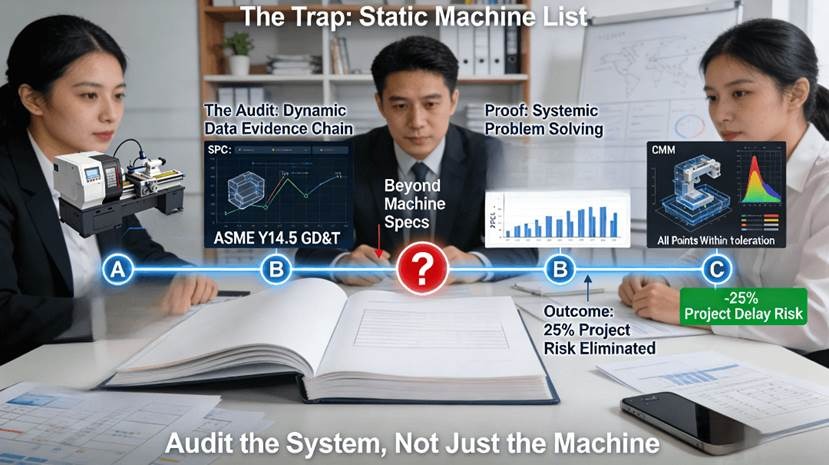
In the cutthroat business of procuring complex 5-axis CNC machined parts, designers and project managers often face a frustrating dilemma. Supplier A boasts a state-of-the-art shop floor with the industry’s leading 5-axis machining centers, only to deliver a product that fails to meet the requirements for dynamic balancing. Supplier B, on the other hand, offers a lower price quote, only to have the surface finish of a prototype’s critical contour fall short of the mark. This disconnect between capability and delivery is a major contributor to delays, rework loops, and cost overruns, causing as many as 25% of complex projects to grind to a halt.
The underlying cause for these problems lies with a major blind spot in the conventional supplier evaluation methodology. Current methods are overwhelmingly focused on the supplier’s static capabilities, with little consideration for the supplier’s true, dynamic capabilities, which are the only ones that can ensure precision, the depth of the supplier’s knowledge database, the real-time nature of the supplier’s processes, and the ability to trace quality metrics. This article presents a proven methodology to break free from the conventional leap of faith approach to supplier selection, to a more scientific “risk management” methodology.
Where Does “Precision” Really Live? Not in the Machine, but in the Process Data
Precision is not an attribute of the machine itself but rather an outcome of the entire system. To illustrate, take the example of a 5-axis center machine cutting an aerospace part made of titanium. The precision of the final part is actually a result of an amalgamation of a thermal compensator, real-time monitoring of the spindle’s vibration, predictions of tool wear, and physical movement of the axes. The only way to determine the precision of the machine is to look at the data on the performance of the features machined on the machine. A savvy auditor would not be satisfied with what the brochure or the salesman tells him or her but would ask for the statistical process control (SPC) charts for the last year for key features like true position or coaxiality.
1. The Digital Thread: From Blueprint to Verified Part
Precision in today’s world is a digital thread that brings design intent, manufacturing instructions, and in-process verification together in a cohesive whole. This is a concept promoted by authorities such as the National Institute of Standards and Technology (NIST), in their publications on smart manufacturing, as a means of ensuring a predictable outcome in manufacturing operations. The level of maturity in a supplier can be gauged by how smooth this thread is, linking each and every machining parameter in a seamless whole.
2. Auditing the Evidence: Asking for the Right Data
When faced with an audit, change the conversation from “What equipment do you have?” to “How about showing me evidence of your ability to control your process?” Ask for documented evidence of a recent project of comparable complexity: the closed-loop corrective action report for a non-conformance, a revised control plan, and a trend analysis of tool life for finishing operations, for example. The ability and willingness to freely share such information is a strong indicator of a well-run operation with a strong systems approach.
3. Translating Data into Project Certainty
The end result of a data-driven audit is, ultimately, de-risking your project timeline and budget. A supplier with a deep, validated process database does not just run your parts; they can forecast results, anticipate potential issues in your design, and prescribe optimal parameters from day one, delivering a statistically certain timeline for your project – a true game-changer in the procurement process, no longer a hopeful promise. To execute this deep dive methodology correctly, a structured approach is necessary. To receive a comprehensive evaluation system, which includes an audit checklist, case studies, and in-depth analysis, refer to this definitive guide on 5-Axis CNC Parts Manufacturing.
How to Decode a “Capability Premium”: Is It a Risk Surcharge or a Value Investment?
When presented with a range of quotes for a custom 5-axis part program, the cheapest offer is not always the best long-term solution. The key is to understand the “capability premium” each supplier is charging. Supplier A may have quoted lower but have vague descriptions of their processes. Supplier B quotes 20% higher but clearly breaks down their costs for programming hours based on simulation, vibration damping fixtures, and first article inspection with full 3D scanning. This is not a surcharge; it is an investment in risk reduction and knowledge capital.
l The Cost of Prevention vs. The Cost of Failure: The “capability premium” is a discount on future risk. The cost of a sophisticated CAM program to eliminate the risk of tool collision is a fraction of the cost of a scrapped, potentially valuable workpiece. The cost of investing in on-machine probing to eliminate the risk of parts going out of spec is a fraction of the cost of discovering a batch of parts out of spec at the final inspection stage.
l Knowledge Capital: The Invisible Asset on the Quote: A substantial part of a justifiable premium is a payment for technical knowledge that has accrued over time. The supplier bidding for a complex impeller part is not just bidding for machine time but is utilizing a proprietary knowledge capital consisting of a database of successful tool paths, optimal cutting conditions for different materials, and optimal fixturing strategies for similar geometries. This is the key to a first-part success and quality. It is an integral part of the overall value being offered by the capable supplier.
l Total Cost of Ownership: Looking Beyond the Unit Price: To accurately compute the 5-axis CNC machine cost calculation, a Total Cost of Ownership (TCO) approach is a necessity. The less expensive supplier is actually shifting costs back to the buyer in terms of delayed timelines for rework, engineering costs for debugging and issues resolution, and lost production time. The capable supplier’s premium is a payment for a reliable part delivered on time and is a key driver for reduced overall costs and faster time to market.
The On-Site Audit Checklist: 3 “Living Systems” to Interrogate Beyond the Factory Tour
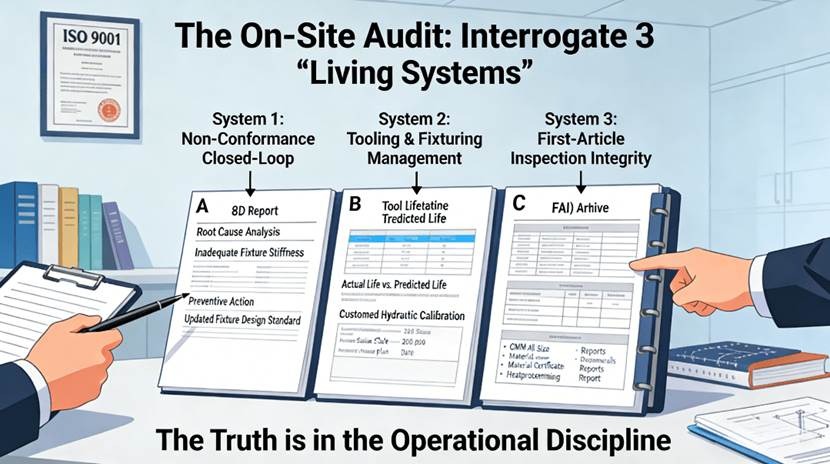
While a factory tour provides insight into the “what” of a facility, a thorough audit needs to get to the “how” of the operational systems. Instead of just looking at the “shiny” parts of the machine tools, the focus needs to be on interrogating the “living systems” to get a better feel of the overall outcome. This is the fundamental requirement to master the art of selecting a 5-axis CNC supplier.
1. The Non-Conformance Report (NCR) Closed-Loop
Select a random Non-Conformance Report. Instead of just reading the problem statement, follow the entire lifecycle of the problem. A good system will have a closed-loop lifecycle where the root cause analysis is complete on an 8D or similar form. This will have a tangible outcome where corrective and preventive actions are taken. The most important question to be asked is whether the corrective/preventive actions have impacted the control plan, a standard procedure, or a preventive maintenance schedule.
2. Tooling & Fixturing Management: The Foundation of Repeatability
Review the logs for high-precision tooling and complex 5-axis workholding operations. Are cutting tool lives being tracked for their full lifespan? Are precision collets and hydraulic chucks being regularly calibrated? For custom workholding fixtures, does a master record exist that includes setup sheets and inspection reports? Tool crib management chaos is a leading indicator of variability on the shop floor.
3. First-Article Inspection (FAI) Integrity
Ask for the full FAI package for a complex part that was delivered recently. A full FAI package includes far more than just a summary sheet. It includes the full data report from a CMM or 3D scan, material certificates, heat treatment certificates, and full results for all dimensions against the drawing. The full package is a reflection of the supplier’s discipline in documentation and transparency. This is a non-negotiable for a CNC machining supplier selection criterion in a regulated industry.
See also: Technology Reshaping the Way Financial Stakeholders Connect
Can Your Supplier “Learn”? Evaluating Breakthrough Capability for New Materials
The ultimate test of a supplier is not only their ability to execute an existing process but also to excel in uncharted territory. If your project requires a new composite material or an unusual geometry, you need a supplier that can perform structured learning and breakthroughs, not just process execution. To test their learning ability, you need to ask questions about their process for achieving breakthroughs.
1. The Structured ‘Test-Cut-Analyze-Optimize’ Protocol: Ask your supplier about their process for qualifying a new material or geometry. Do they have a protocol that outlines the DOE (Design of Experiment) process, analysis techniques (such as microscopic analysis of test cut surfaces or force analysis), and feedback to their CAM programming system? A supplier who thinks about new challenges as R&D challenges, rather than guesswork, is taking a scientific approach to Manufacturing Innovation.
2. Evidence of Past Problem Solving: Request that you be provided a detailed technical case study or white paper that outlines how they solved some previous advanced problem. This is not marketing blurb but a detailed explanation of the initial problem, the process of analysis, hypotheses tested, etc., that leads up to the final solution validated through data analysis.
3. Resources for Sustained Innovation: Determine if they have resources in place to address future issues that will be thrown up by these problems. Do they have simulation software for cutting dynamic analysis and engineers who can effectively use this software? Do they have relationships established with material vendors or university research institutions? A company that rigorously follows standards such as IATF 16949 has already integrated knowledge management into their processes, creating an organizational ability to learn, where innovations in complex part manufacturing are not just individual skills but organizational knowledge.
From Prototype to Production: Does the “Handoff” Lose Critical Knowledge?
While a perfect prototype is a wonderful achievement, it does not guarantee a perfect production outcome. In fact, many projects end up in a graveyard of abandoned efforts where a prototype was successful, but production was not, primarily due to a lack of continuity in knowledge transfer from prototype to production.
1. The “Digital Thread” in Practice: From Prototype to Control Plan
An elite supplier will ensure a smooth prototype-to-production “handoff” by employing a strategic digital thread approach for their manufacturing operations. All parameters learned during the prototype phase, such as optimal feed rates, specific tooling, and in-process inspection, must be systematically captured and structured into a production control plan, work instructions, and set-up sheets, etc. The audit will seek verification of this requirement by comparing prototype documentation with production documentation for a past project, ensuring consistency and formalization of best practices learned during prototype development.
2. Ensuring Process Stability at Scale
While precision is achieved by repetition, scaling precision requires controls, and the supplier must show how they ensure their precision 5-axis CNC machining process remains stable across many machines, shifts, and operators. This includes statistical controls like Gage R&R studies for validation of measurement systems as well as ongoing SPC control of key characteristics during production runs. This is a systemic approach to precision 5-axis CNC machining, where the 1000th part is as perfect as the first.
3. The Role of Digital Integration and Supply Chain Theory
This free flow of knowledge and quality is the practical application of the latest supply chain theories. The APICS SCOR model, for instance, highlights the importance of reliability, agility, and responsiveness as essential supply chain performance characteristics. The supplier with the highly developed digital thread represents the epitome of a reliable and responsive manufacturer, making them a cornerstone of true Supply Chain Optimization, as well as a lower-risk supplier for mission-critical production. Ultimately, the translation of a highly rigorous audit framework into the production of thousands of identical, complex pieces depends on the highly experienced 5 axis CNC machining manufacturer.
Conclusion
Choosing a partner for 5-axis CNC is one of the most significant and systemic decisions that a company may make in its journey of providing high tech manufacturing solutions. The consideration factors go way beyond procurement or simple cost-saving. It could mean success/failure of your products, viability of your project and your image or reputation company-wide. If you make a decision that is of a high level of risk by simply looking at your gut feelings or intuition, you are prone to be mistaken. On the other hand, if you use an audit approach that is evidence-based that critically examines the process, the system maturity, and the organization’s learning capability, you may not only avoid making a risky decision, but you will possibly get hold of an amazing chance of securing a sustainable competitive advantage. Adopting this approach of building a supply chain that is both resistant and intelligent will be a strong spur for innovation and will enable industrial automation transformation from both a technological and a physical point of view.
FAQs
Q: What is the most important piece of information to request from a potential 5-axis CNC supplier before an audit?
A: Request a fully redacted Project Dossier for a previous project similar to yours. This should include the quality plan, process sheets with rationale, inspection results, final reports, and any corrective actions. Nothing else will give you such an incredible level of detail and transparency as their internal discipline and systems thinking.
Q: How can we assess the effectiveness of their current process control systems from a remote distance?
A: Request a view of a live dashboard (redacted) showing key machine condition metrics and SPC charts. Also, request a screen-share walkthrough of their CAM simulation for a complex toolpath, showing how they mitigate potential issues like chatter or tool deflection before even starting the machine.
Q: How long should it take to perform a detailed level of supplier qualification like this?
A: Allow a minimum of 8 to 12 weeks for a thorough qualification process from the start of the RFQ and document review, through the audit, a trial order, to full qualification. This is a worthwhile investment for a strategic component that could impact operations for years to come.
Q: Is a supplier with older equipment but extensive process data better than one with state-of-the-art equipment but minimal data-based proof?
A: The supplier with extensive process data is generally safer than one that has minimal data-based proof of its processes. The data allows for predictable outcomes and control of processes, even on well-maintained older equipment. The state-of-the-art machine is an untested asset, whereas data is a guarantee.
Q: How do we evaluate their ability to manage changes in our product’s design efficiently during production?
A: Ask them if they have an ECO process in place. A professional supplier will have a process in place that allows them to evaluate changes based on cost, schedule, and tooling, and make changes quickly, including simulation of changes and implementation of changes with proper documentation of inspection updates.
Author Bio
The content of this article is based on the authors long-standing experience in engineering and project management, especially in the production of complicated 5-axis CNC pieces for industries such as aerospace and medical devices. Their comments come from a real-world perspective of the difficulties in turning intricate designs into dependable, high-quality parts. LS Manufacturing is a certified manufacturing partner who is dedicated to blending controlled engineering procedures and experimental thoroughness in every joint effort. Contact them today to ensure the success of your next complex 5-axis component project.