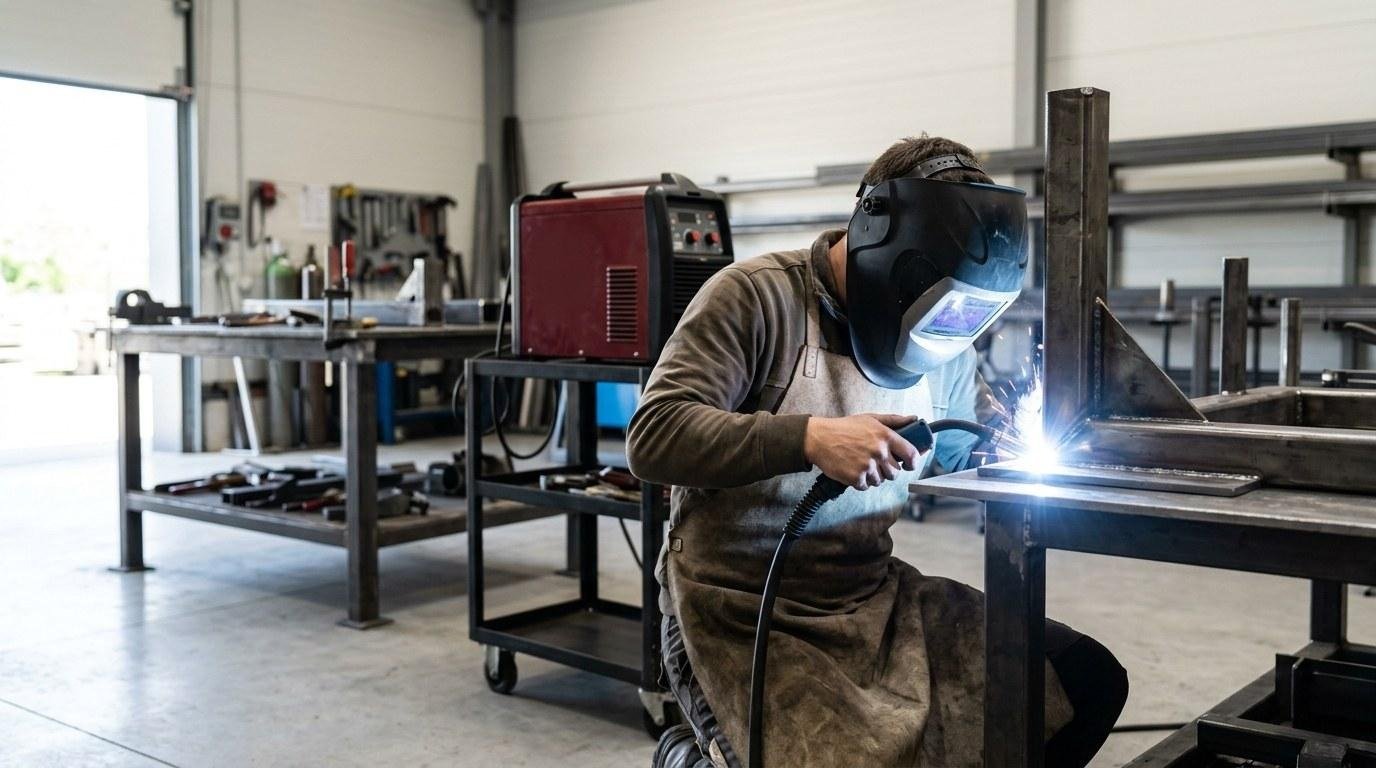
Modern inverter technology allows for a more stable arc, resulting in cleaner, stronger welds.
By a welding industry contributor. Picking a new MIG welder used to be easy: you just bought the most power you could afford. But new electronics have changed the game. Today, focusing only on a machine’s max power can lead you to buy a tool that fights you on every weld. This creates messy spatter and extra work that costs time and money. The real value is now in the quality of the welding arc and how smart the machine is.
This change matters for both professionals and serious hobbyists. The U.S. Bureau of Labor Statistics says the median pay for welders is $53,750 per year. Equipment that helps you work faster and clean up less can help you earn more. The newest inverter-based welders give you much more control than older, transformer-based ones. Looking at the features of a modern miller electric mig welder shows that technology once only for big factories is now available for smaller shops.
A steady, predictable arc not only makes better welds but also helps create a safer workplace. The Occupational Safety and Health Administration warns that welding can expose workers to harmful metal fumes and ultraviolet radiation. A smooth arc with very little spatter can help reduce the amount of fumes created. This works along with important safety gear and proper fans.
Quick answer: When choosing a MIG welder today, focus on arc control features like synergic settings and inductance control instead of just high power. Modern inverter welders are lighter, use less electricity, and make better-looking welds. This saves a lot of time on cleanup for both hobbyists and professional welders.
What’s inside
- Why Has Inverter Technology Changed Everything?
- How Do You Evaluate a Welder’s Duty Cycle?
- What Is “Synergic Control” and Do You Need It?
- Frequently Asked Questions
- Matching the Machine to the Mission
Why Has Inverter Technology Changed Everything?
Inverter welders are lighter, use less power, and give you better digital control over the welding arc than old transformer machines. This change from heavy copper coils to smart electronics is the biggest update in welding gear in the last 20 years. It has completely changed what a welder can do, especially for small shops or for work on the go.
The main difference is how the machine changes power from a wall outlet into power for welding. A traditional transformer uses huge, heavy coils of wire, which makes the machine big and inefficient. An inverter uses electronics to increase the power’s frequency first. This lets it use a much smaller, lighter transformer. This process also lets a computer chip directly control the power output, allowing for new features that weren’t possible before.
This digital control is what makes these welders so valuable. It lets the machine adjust the arc thousands of times per second. This creates a more stable, predictable, and clean weld puddle with far less spatter. For big companies, these small improvements add up. The U.S. Bureau of Labor Statistics reports that there are about 63,500 welders, cutters, solderers, and brazers in transportation equipment manufacturing alone. In a field that big, saving a few minutes of cleanup on each weld adds up to huge savings on labor costs.
❝ A good rule of thumb is that a modern 200-amp inverter MIG welder will weigh less than half of an older transformer machine with the same power output. This makes a huge difference for portability and shop space.
This technology is also more important for a welder’s career. The U.S. Bureau of Labor Statistics says that jobs for welders are expected to grow by only 2 percent through 2035. Slower growth often means more competition for jobs. Welders who can do higher quality work more quickly will have an edge. Learning to use equipment with advanced arc control is a clear way to work faster and improve the final product.
How Do You Evaluate a Welder’s Duty Cycle?
A welder’s duty cycle tells you how long it can weld at a certain power level in a 10-minute window. It’s the key to matching a machine to how you work. It is not a measure of quality, but of what the machine is built for. A welder with a lower duty cycle isn’t worse; it’s just made for different kinds of jobs.
The rating is shown as a percentage. For example, a 30% duty cycle at 180 amps means the machine can weld for three minutes straight at that power. Then, it must cool down for the next seven minutes. If you keep welding, a safety switch will turn the machine off to prevent damage. This is a very important number to check, because a machine that keeps shutting down will ruin your workflow.
❝ When comparing models, look for the duty cycle at the amperage you will actually use. A manufacturer might advertise a 100% duty cycle, but only at a very low power setting. The important number is the duty cycle for the thickness of metal you work with most frequently.
The link between power and duty cycle is simple: when you turn the power down, the duty cycle goes up. A machine might have a 30% duty cycle at its highest power but a 100% duty cycle at half that power. That’s why it’s important to look at all the numbers, not just the one in the ads. Groups like the American Welding Society (AWS) help set the standards so you can compare machines fairly.
Consider the pace of your work. Are you making long, continuous welds on thick metal, or are you making hundreds of short tack welds? A person doing tack welds may never hit the duty cycle limit, even on a light-duty machine. A fabricator welding a long seam on a frame will need a much higher rating to work well.
Typical Duty Cycle vs. Amperage
| Amperage Setting | Duty Cycle (%) | Weld Time (in 10 min) | Cool Time (in 10 min) |
| 250A (Max Output) | 40% | 4 minutes | 6 minutes |
| 200A | 60% | 6 minutes | 4 minutes |
| 155A | 100% | 10 minutes (continuous) | 0 minutes |
The temperature of the air around you also matters. Most makers test their machines at 104°F (40°C). If you are working in a cooler 70°F shop, your actual duty cycle will be longer. If you are welding outside on a hot day, it will be shorter.
What Is “Synergic Control” and Do You Need It?
Synergic control automatically adjusts the welder’s voltage to match your wire feed speed. This makes setup easier and creates a more stable arc. For many welders, especially beginners or those in busy shops, this feature is a huge time-saver that helps make welds better and more consistent.
With a normal MIG welder, you have to balance two settings by hand: wire feed speed (WFS) and voltage. If the voltage is too high for the wire speed, the arc gets messy and creates spatter. If it’s too low, the wire can jam into the metal. Finding the right balance takes practice and test runs. Synergic control gets rid of the guesswork. You just tell the machine your wire size and gas type. Then, you only need to turn one knob, usually for wire speed or metal thickness. The machine’s software looks up the best settings and adjusts the voltage for you as you weld.
❝ When you are testing a machine with this feature, ask the salesperson to set it for a specific material, like 1/8-inch mild steel. Run a bead. It should sound smooth, like frying bacon. Then, ask what happens if you try to weld 1/4-inch steel on that same setting. A well-tuned synergic program should run noticeably worse on the thicker plate, because it is set up for the 1/8-inch material. If the arc feels about the same on both, the program may be too generic to be truly helpful.
This “one-knob” control is very valuable for shops that do the same tasks over and over, as it makes sure every welder uses the same best settings. It also makes it much easier for new welders to learn. Instead of fighting with machine settings, they can focus on their technique: travel speed, gun angle, and reading the weld puddle. Expert welders might still like the fine-tuning of manual mode for special jobs, but a good synergic system gives you a great starting point that only needs small tweaks. It makes setup a quick and easy process instead of a chore.
Frequently Asked Questions
How do I choose the right MIG welder for my needs? Think about the thickest metal you weld most often, not just the max power on the box. Check your power outlet. You’ll need a 240V outlet for most welders that can handle metal thicker than 1/4 inch. Also, think about how easy it is to carry. If you travel for work, a lighter inverter model will make a big difference.
Are 120V-input MIG welders powerful enough for real work? Yes, they work very well for certain jobs. A 120V machine is great for car body panels, exhaust pipes, and working on steel up to about 3/16-inch thick. They are easy to carry, which is a big plus for repairs on the go. For building frames or welding anything thicker, you will need the extra power and duty cycle of a 240V machine.
How should I evaluate the long-term value of a welder? Look at more than just the price tag. Check the cost and how easy it is to find parts you’ll replace often, like contact tips, nozzles, and drive rolls. A welder with special parts that are hard to find can be a problem. Also, check the warranty and the company’s reputation for service. A dependable tool with good support is usually cheaper over time.
What makes a premium welder brand worth the investment? Well-known brands usually have a better welding arc. This means less spatter, more control over the weld puddle, and less cleanup. This is because they spend a lot on research and development. You are also paying for a tougher machine, better customer service, and a welder that will be worth more if you sell it later.
Should I consider a multi-process welder? A multi-process welder that can do MIG, TIG, and Stick welding is very flexible and can save space in a small shop. It’s a great choice if you work with many different materials and types of joints. The main downside is that a machine built for only one process might have more special features or work slightly better for that one task.
Matching the Machine to the Mission
Choosing a MIG welder today is about more than just matching power to metal thickness. Inverter technology brings in key things to consider, like how easy it is to carry, arc stability, and digital control. These features directly affect how fast you work and the quality of your welds. Your main job is to figure out how a machine’s design fits the way you work, not just its top power number.
The biggest choice is between manual control and automatic help. Synergic controls are tools that help you work faster. They cut down on setup time and give you consistent settings, which means less time grinding off spatter. You are choosing between a smarter tool that helps your skills, or a basic tool that relies on your experience to set it up for every job.
The best way to judge a welder is to use it. Don’t just ask what it can do at its max power. Ask what it does for the 90% of the work you do every day. How does its duty cycle match up with how you work? The right machine helps you work better by making clean welds with less effort. That is the real way to measure its value.
About the author
Welding Supplies from IOC is an e-commerce distributor specializing in welding machines, plasma cutters, safety equipment, and related consumables. As an authorized online dealer for major brands including Miller Electric and Lincoln Electric, the company serves a wide range of users from career welders to weekend hobbyists. Their platform features equipment organized by process type and skill level, providing technical resources to support welders in selecting appropriate tools for projects in fabrication shops or for mobile repair work.