A proper repair integrates new materials to restore the entire roofing system.
By a roofing industry contributor.
That small water stain on the ceiling is easy to ignore. You might tell yourself it’s a one-time thing from a weird storm. But that visible spot often points to a much larger, hidden issue. By the time water damage is visible inside your property, the underlying sheathing, insulation, and even structural supports may already be compromised. What could have been a straightforward fix has now become a more complex and costly problem.
The roofing industry itself is evolving to meet new challenges. Demand for skilled professionals is growing steadily; the U.S. Bureau of Labor Statistics projects that employment for roofers will grow 5 percent between 2025 and 2035. This demand, combined with more advanced materials and diagnostic tools, means that understanding what goes into modern, reliable roof repair services is crucial for making an informed decision. It’s no longer just about patching a visible leak.
The stakes are high, both for your property and for the people performing the work. Roofing is a dangerous profession that requires rigorous safety protocols. In 2023, roofing contractors accounted for 26.0 percent of all fatal falls, slips, and trips in the construction industry, according to the U.S. Bureau of Labor Statistics. This data highlights why proper training, insurance, and a commitment to safety are non-negotiable elements of any legitimate repair project.
Quick answer: A proper roof repair addresses the root cause of failure, not just the symptom you can see. It involves a thorough inspection of the entire roofing system, including decking, underlayment, and flashing. The goal is to integrate new materials seamlessly with the existing roof, ensuring the repair will last.
What’s inside
- What are the real costs of a cut-rate roof repair?
- How Do You Evaluate a Roofer’s Repair Plan?
- How Does a Roofer Trace a Leak Back to Its Origin?
- Frequently Asked Questions About Roof Repair
What are the real costs of a cut-rate roof repair?
A cut-rate repair often costs more in the long run through premature failure, property damage, and the significant liability you assume when hiring an improperly trained or uninsured crew. The initial savings on a low bid for a residential roof repair can be quickly erased by the expense of re-doing the work correctly or fixing new problems caused by a faulty patch. It’s a classic case of treating a symptom while ignoring the disease.
The most severe risk isn’t just financial. Roofing is inherently dangerous work, and safety protocols are not a place to cut corners. According to the U.S. Bureau of Labor Statistics, roofing contractors accounted for a staggering 26.0 percent of all fatal falls, slips, and trips within the construction industry in 2023. If a contractor working on your property does not have adequate liability and workers’ compensation insurance, you could be held financially responsible for accidents. Always verify a contractor’s insurance certificates before allowing any work to begin.
Furthermore, the market for skilled labor is tight. The U.S. Bureau of Labor Statistics projects that the demand for roofers will grow by 5 percent through 2035. This growth means that experienced, qualified technicians are in high demand and are unlikely to be working for the lowest bidder. A suspiciously low price can be a red flag that a company is using undertrained labor, which often leads to repairs that fail to integrate with the existing roofing system.
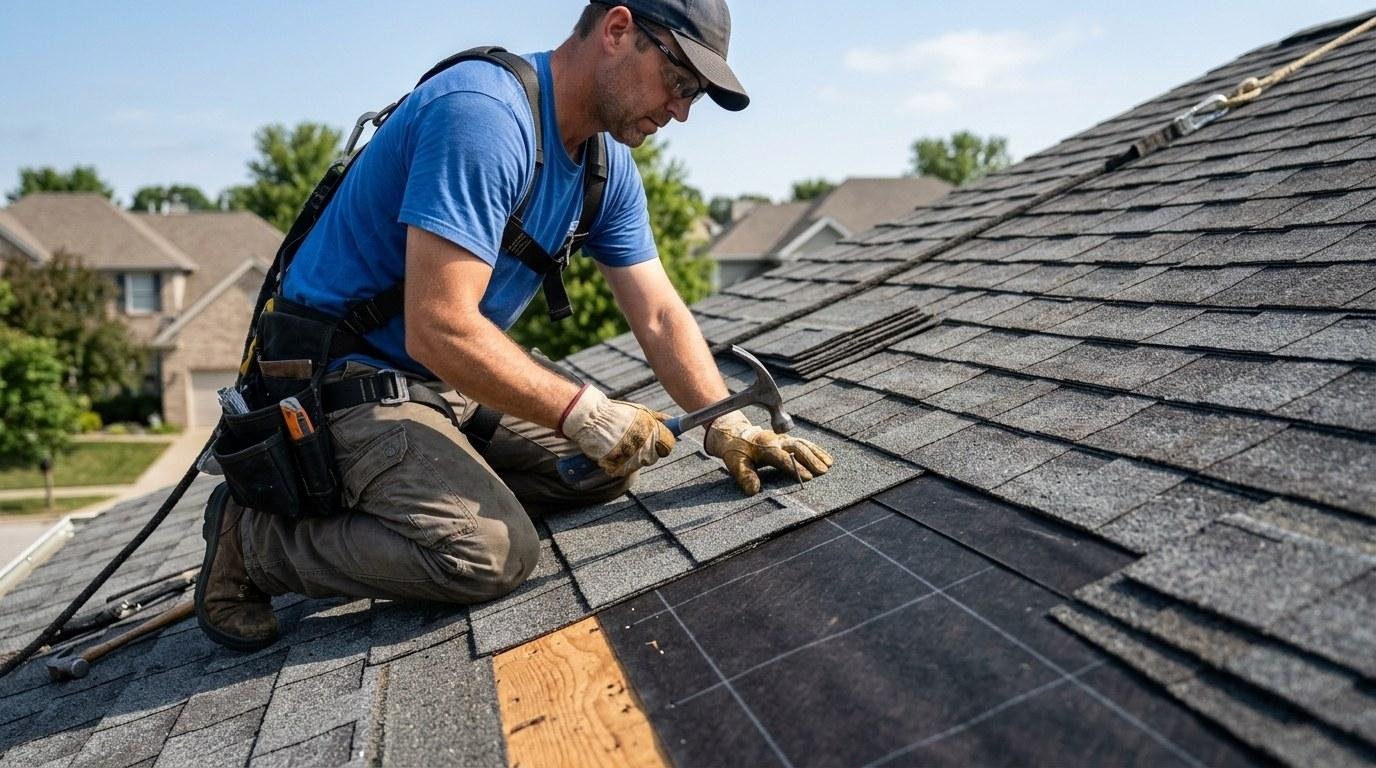
❝ A repair patch should never be just a new shingle over an old problem. A professional will always remove the damaged materials down to the roof deck, inspect the wood for rot, and then build the layers back up: ice and water shield, underlayment, and finally the new shingles, woven into the existing ones. This is the only way to ensure the repair is as durable as the rest of the roof.
Ultimately, a successful repair is one that you don’t have to think about again. It restores the integrity of your entire roofing system, not just the one spot that was leaking. Investing in a properly diagnosed and executed repair by a qualified professional protects your property’s value and prevents small issues from escalating into structural emergencies.
How Do You Evaluate a Roofer’s Repair Plan?
You evaluate a roofer’s plan by looking for specific details that go beyond the surface patch, verifying their credentials and insurance, and asking pointed questions about their methods. A professional proposal is a diagnostic document, not just a price tag. It should clearly outline the root cause of the problem and the specific steps required to fix it permanently. Vague, one-line quotes like “Fix roof leak: $500” are a significant red flag.
A detailed scope of work should itemize the process. Will the contractor remove the old shingles, or just cover them? Will they replace the felt paper or synthetic underlayment, which is the roof’s secondary water barrier? Will they inspect the wooden roof deck for rot or soft spots once it’s exposed? These are critical steps. Professional trade groups like the National Roofing Contractors Association provide guidance for homeowners to help them evaluate potential contractors and understand the hallmarks of a quality job. Look for a plan that treats your roof as an integrated system.
❝ Ask a potential contractor if they can provide a certificate of insurance (COI) that names you, the property owner, as an additional insured. This is a crucial step. A generic COI proves they have a policy, but a certificate issued specifically for your project confirms that their coverage is active and applies to the work being done on your property.
The table below shows the difference between a temporary fix and a proper system repair.
| Feature | Quick Patch (High Risk) | System Repair (Low Risk) |
| Scope | Covers the visible hole only. | Removes materials to expose the deck. |
| Underlayment | Ignores or patches over old material. | Replaces underlayment in the repair area. |
| Flashing | Reuses or caulks around old flashing. | Installs new, properly integrated flashing. |
| Integration | Shingles may be face-nailed or poorly sealed. | New shingles are woven into the existing field. |
| Durability | Prone to failure in the next storm. | Designed to last as long as the rest of the roof. |
Finally, ask specific questions about technique. Inquire about how they plan to manage water diversion around chimneys and vents using flashing, not just sealant. Ask what type of underlayment they will use and why it’s appropriate for your roof’s pitch. A contractor who can explain the “why” behind their material choices demonstrates a deeper level of understanding.
How Does a Roofer Trace a Leak Back to Its Origin?
A roofer traces a leak by working backward from the interior damage, understanding that water can travel a long way from where it first enters the roof. The spot on your ceiling is just the end of the journey. The real work is in finding the starting point, which is almost always higher up on the roof plane than where the water stain appears.
Water rarely drips in a straight line. Once it gets past your shingles, it follows the path of least resistance. This path could be the top of a rafter, the slope of the underlying roof deck, or even an electrical conduit in the attic. Water can travel ten to fifteen feet sideways before it finds a seam in the plywood or a nail hole to drip through. This is why a technician who only inspects the shingles directly above the interior stain will often miss the actual source of the problem.
The most common entry points are not in the open field of shingles, but at penetrations and transitions. These are places where the roof is pierced by a vent pipe, a chimney, or a skylight, or where one roof plane meets a wall. These areas are protected by flashing, which are metal components designed to direct water over and around the joints. When flashing fails due to corrosion, improper installation, or storm damage, it creates a direct channel for water to get beneath the primary roofing material.
❝ A common mistake is to fixate on the shingles directly above an interior water stain. An experienced technician knows to look uphill from that point. They will inspect every seam, nail, and piece of flashing in the entire watershed area that feeds down to where the leak is showing up.
The diagnostic process is methodical. It often begins in the attic, looking for water-stained wood, damp insulation, or daylight. This helps narrow the search area on the roof’s surface. From there, the roofer will inspect for subtle clues: cracked sealant at the base of a vent, a nail that has popped up slightly, or a corner of step flashing that has pulled away from a chimney. For the most elusive leaks, a controlled water test using a hose can be used to isolate different sections of the roof until the entry point is confirmed. This detailed investigation is what ensures the repair addresses the cause, not just the symptom.
Frequently Asked Questions About Roof Repair
Do I need a full replacement, or is a repair enough? The decision often depends on the age of your roof and the extent of the damage. If your roof is nearing the end of its expected service life (typically 20 to 25 years for asphalt shingles) or if more than 30% of its surface is damaged, a replacement is usually the more cost-effective long-term solution. For newer roofs with isolated damage, a professional system repair is a perfectly sound approach.
How long should a professional roof repair last? A properly executed repair should last for the remaining life of your existing roof. This is why a “system repair,” which rebuilds all layers from the deck up, is so critical. Be sure to ask about the workmanship warranty on the repair itself, which is separate from the manufacturer’s warranty on the new materials used.
What’s the difference between functional and cosmetic storm damage? Functional damage impairs the roof’s ability to shed water and protect your home. This includes things like hail strikes that have fractured the shingle mat or significant granule loss that exposes the underlying asphalt. Cosmetic damage, such as minor dents on metal flashing or vents, doesn’t compromise the roof’s integrity. Most insurance policies are designed to cover functional damage.
Will the new shingles perfectly match my old ones? Achieving a perfect color match can be difficult, especially on an older roof that has been exposed to sun and weather. Shingle manufacturers produce shingles in batches, and granule colors can vary slightly from one batch to another. A good contractor will get the closest possible match, but you should expect to see a slight difference in color and texture.
Can I put a tarp on my roof myself while waiting for a repair? You should avoid getting on a damaged or wet roof yourself due to the extreme safety risks. If you can safely place a tarp from a ladder at the roof’s edge to cover a small, low-slope area, that may be an option. However, for most situations, it is far safer to wait for an insured professional who has the proper safety equipment to secure the area.
The Real Goal of a Roof Repair: Durability, Not Just a Dry Ceiling
Ultimately, a successful roof repair is not measured by whether the dripping stops tomorrow, but by whether that section of the roof performs flawlessly for the rest of its intended lifespan. The temptation to opt for a quick, inexpensive patch is understandable, but it often treats a symptom while leaving the underlying cause unaddressed. This approach almost guarantees a repeat failure, often during the next severe storm when contractors are busiest. A lasting solution requires thinking of your roof as a complete system of integrated layers, not just a surface of shingles.
Your most effective tool as a property owner is the ability to distinguish between a simple price quote and a genuine diagnostic plan. A detailed proposal that outlines the removal of old materials, inspection of the deck, and replacement of underlayment is a sign of a professional who understands system integrity. By focusing your evaluation on the thoroughness of the proposed work, you shift the conversation from cost to value. The goal is to buy a permanent solution, not to rent a temporary fix that leaves your home vulnerable.
About the author
Reliable Roofing & Restoration Inc. is a family-owned roofing contractor based in Colorado. Since 1997, the company has provided residential and commercial roofing services along the Front Range, with a focus on storm damage restoration and assisting property owners with the insurance claims process. As a GAF Master Elite Contractor, a certification held by a small percentage of roofing professionals, their team handles projects from initial inspection to final installation, working with various systems for both steep-slope and flat-roof applications.