When a major incident occurs at work, it is rarely a single major failure that has caused it. Instead, it is a series of minor failures that have gone untracked, uncorrected, and unresolved. Purpose-built EHS management software exists precisely to close those gaps, turning fragmented safety activity into a coherent, measurable, and defensible program. In industries as different as waste management and heavy manufacturing, organizations that have made this transition report that the same phenomenon occurs: safety stops feeling like a reactive function and starts feeling like a real business function.
The article seeks to explore the need for structured EHS technology in practice, what it does, why the time is right, and how organizations of various sizes can benefit from the transition.
The Growing Importance of Workplace Health and Safety
The moral importance of occupational safety has always been a significant concern. However, over the past decade, the business implications of occupational safety have become more defined. This is particularly evident in the stepped-up activity by regulatory bodies in the United States and globally, with respect to both record-keeping and penalty structures for non-compliance. Insurers have also become more sophisticated in linking premiums with incident history and maturity.
The end result is that the topic of workplace safety has shifted from the periphery of the way in which an organization is managed to the core of it. The C-suite and the boardroom, as well as the institutional investors who fund the company, are inquiring about safety performance. They’re inquiring about it because it’s the right thing to do, and they’re also inquiring about it because the risk of financial exposure related to an ineffective safety program is quantifiable.
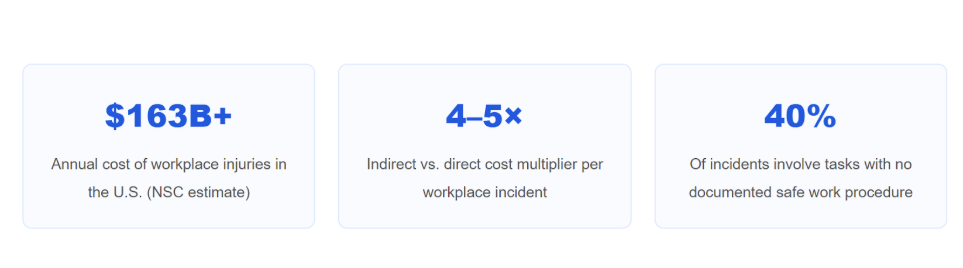
The environment that safety managers must navigate has created a dual mandate: protect employees from harm and protect the organization from the downstream consequences of that harm. These two goals are not in tension; they’re mutually reinforcing. But they can only be achieved through systems, not good intentions.
Understanding Modern EHS Management Systems
The term EHS, Environmental, Health, and Safety, describes a broad operational discipline, and a modern EHS management system reflects that breadth. Rather than focusing on a single dimension of safety management in a piecemeal fashion, a well-architected EHS system is an integrated layer of operations that links people performing safety work, data generated by those people, and processes that convert that data into decisions.
This means that, from a practical perspective, bringing together incident reporting, inspection and audit management, training records tracking, corrective action processes, risk management processes, and regulatory compliance management within a single environment is necessary. For organizations that operate commercial vehicles, a fully integrated EHS solution would extend to include fleet safety processes such as driver qualification files, DOT compliance, vehicle maintenance audits, and accident analysis within a single environment.
The architectural difference between a modern EHS system and its predecessors, such as binders, spreadsheets, and forms, is not just a matter of ease. It is a matter of accountability. A spreadsheet may show you what happened. A connected EHS system shows you, and others, what happened, who was responsible for response, what was done, and if the incident was addressed in a timely fashion. This is a huge difference if a regulator wishes to review your history.
How Technology Helps Prevent Workplace Incidents
Prevention is the aspect of safety management that receives the least recognition from the outside world. Why? Because if we are successful, nothing happens. There is no injury to report, no fine to pay, no investigation to conduct. The absence of something is hard to make visible. Technology can help make our work visible.
One of the most concrete ways is through near-miss reporting. Safety cultures that have matured and grown as an organization recognize that near misses represent the most underutilized leading indicator they have. A worker who almost slips on an undesignated wet floor, or who narrowly avoids touching a live wire, has just given the safety team critical intelligence that could prevent a serious injury. Yet near misses tend to be underreported in manual systems because of too much friction and too little confidence that anything will change as a result.
Near-miss events are estimated to precede serious injuries at a ratio of several hundred to one. Organizations that surface and act on near-miss data have a fundamentally different risk profile than those that don’t.
The digital EHS tool eliminates barriers to reporting since it places the reporting process on an employee’s mobile phone, an item they already carry. A near-miss incident is recorded in under two minutes, assigned to a supervisor, and tracked through resolution. Patterns on where and how near misses occur become visible in aggregate, identifying systemic issues that create individual incidents.
Similarly, automated inspection scheduling does the same. Instead of relying on a supervisor or a team leader to remember which machine needs an inspection or which certification is due in the next quarter, the automated system does it. It sends reminders at specified time intervals. The inspections that are skipped in a manual process, not because of lack of time or resources, but because of the sheer complexity of operations are completed because it is hard to skip them with the automated system.
Benefits of Digital EHS Platforms for Organizations
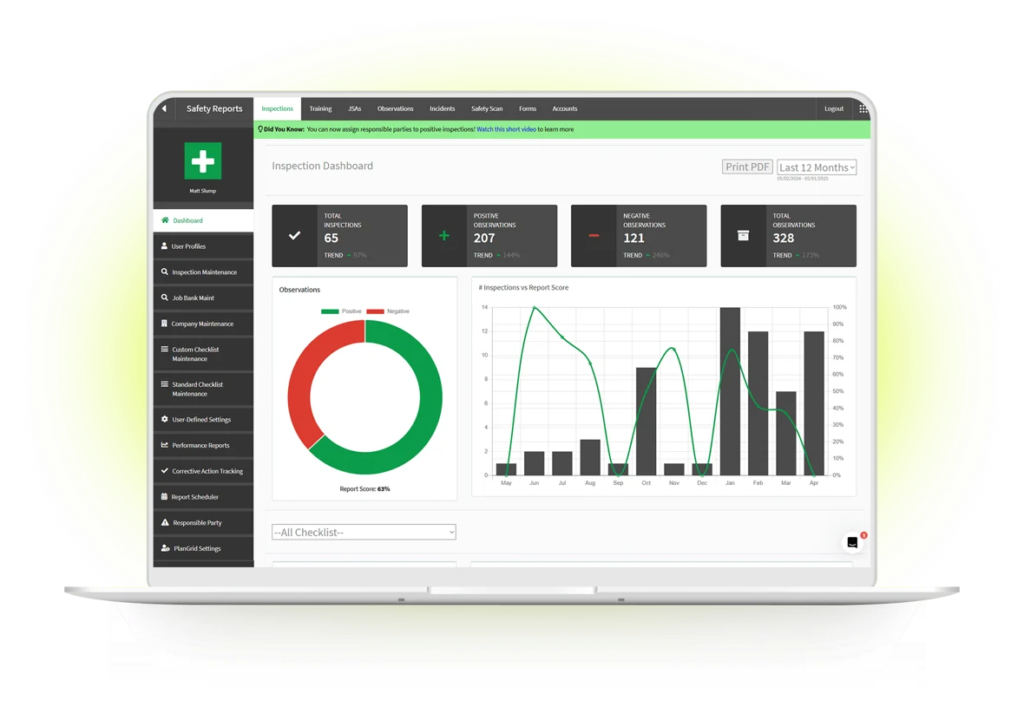
The benefits of transitioning to a dedicated EHS platform span three broad categories: operational efficiency, compliance confidence, and safety culture.
On the operational side, the time savings are substantial and immediate. Safety professionals who previously spent hours each week manually compiling inspection data, updating training matrices, or building OSHA summary reports find that most of this work happens automatically once the system is properly configured. That time gets redirected toward the higher-value activities that software can’t perform, talking to frontline workers, conducting meaningful risk assessments, and investigating incidents with appropriate depth.
Compliance confidence comes from knowing that your documentation is complete, timestamped, and accessible when it needs to be. Organizations that have experienced an OSHA inspection under a paper-based system will recognize the anxiety of scrambling to locate records on short notice. In a well-maintained digital EHS environment, producing a year’s worth of inspection records, corrective action history, or training completions is a matter of applying a filter and exporting a report.
The cultural dimension is subtler but arguably the most durable. When workers see that the observations they submit lead to visible action, a hazard gets corrected, a procedure gets updated, or a piece of equipment gets replaced, their trust in the safety program deepens. That trust is what converts passive compliance into active participation. And active participation, sustained over time, is what reduces injury rates in ways that no software product can claim sole credit for.
For organizations managing fleets alongside their physical operations, the integration of fleet safety data into the same platform amplifies all of these benefits. Vehicle incidents, driver qualification gaps, and DOT compliance obligations don’t live in a separate silo; they feed into the same dashboards, the same corrective action workflows, and the same executive reporting that governs the broader EHS management software program.
See also: Navigating Corporate Finance in a Global Business Hub
Why Companies Are Investing in Safety Technology
The business case for EHS technology investment has never been cleaner. The combination of rising regulatory expectations, greater workforce mobility, and the demonstrated limitations of manual systems has created conditions where the question is less often “should we invest?” and more often “how quickly can we implement?”
Companies with distributed operations, multiple job sites, regional offices, and contractor workforces face a particular version of this challenge. Maintaining consistent safety standards across locations is genuinely difficult when your tools don’t travel. Cloud-based EHS management software solves this structurally: the same inspection template, the same training requirement, and the same corrective action standards apply whether a team is in Texas or across the country, because the platform is the same regardless of location.
Insurance considerations are another driver. Underwriters increasingly ask about the sophistication of an organization’s safety management infrastructure when evaluating workers’ compensation and general liability premiums. A demonstrable EHS program with consistent documentation, low incident trends, and closed corrective actions is a meaningful differentiator in those conversations.
Talent and retention dynamics also play a role that doesn’t always surface in the ROI conversation but is real nonetheless. Workers, particularly in industries with significant physical risk, pay attention to how seriously employers take safety. Organizations with credible, visible safety programs tend to attract and retain workers more effectively than those where safety exists primarily as a wall poster.
Finally, there’s the question of scale. As organizations grow, the administrative complexity of a manual safety program grows with them, but not linearly. It grows exponentially. A digital platform that handles ten sites handles a hundred sites with the same infrastructure. That scalability is part of what makes EHS technology investments compound in value over time rather than depreciate.
Conclusion
The organizations that lead on workplace safety aren’t necessarily the ones with the largest safety departments or the most comprehensive policy manuals. They’re the ones that have built systems capable of capturing what’s actually happening on their sites, routing that information to the right people, and closing the loop before small problems become serious ones.
A well-implemented EHS management system is the infrastructure behind that capability. It doesn’t replace safety leadership or frontline vigilance; it amplifies both, giving safety professionals the data and the tools to do their jobs with greater precision and confidence.
For any organization still managing safety through disconnected spreadsheets or paper-based workflows, the transition to a digital platform represents one of the highest-return operational improvements available. The cost of staying still is no longer theoretically, it shows up in incident rates, insurance premiums, regulatory findings, and the confidence of the people doing the work. Investing in the right EHS management software is, at this point, simply sound operational practice.