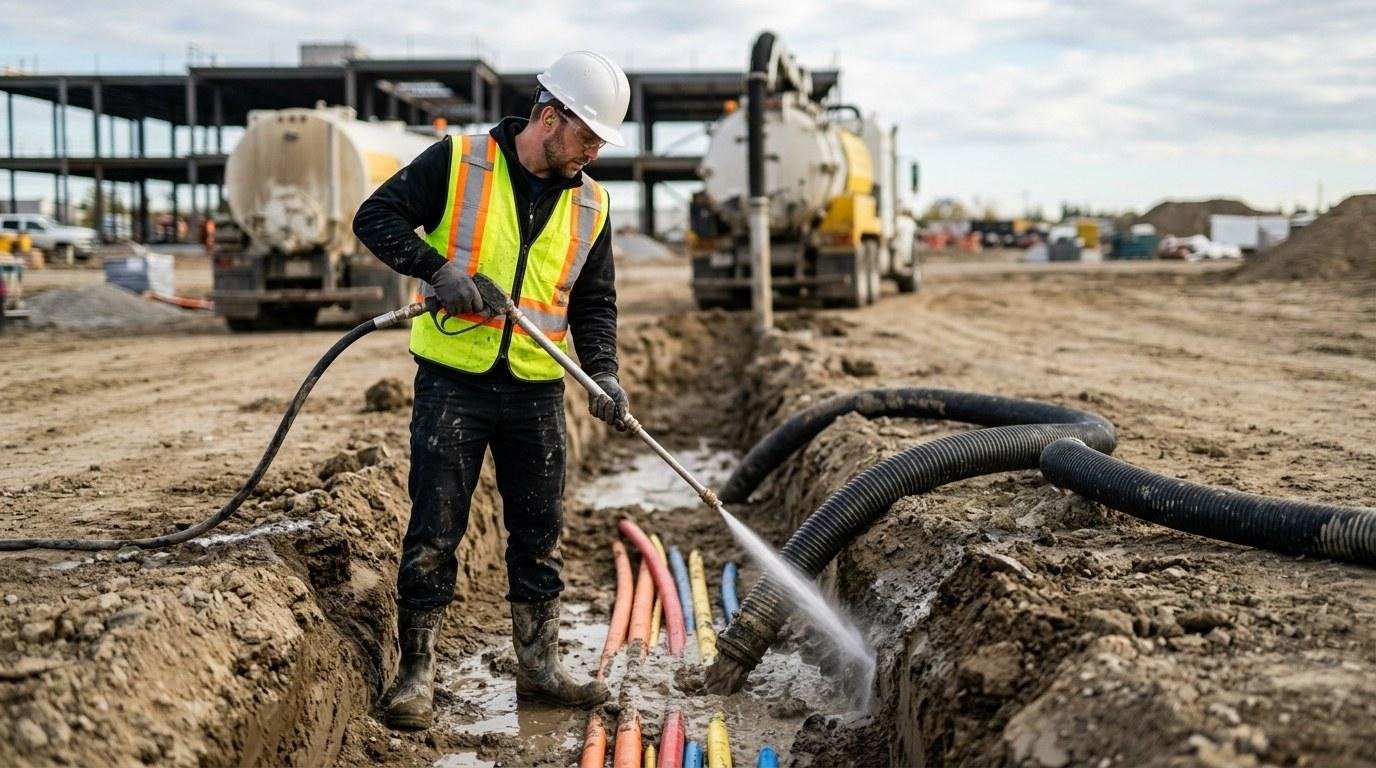
Modern hydro excavation provides a precise and safe alternative to traditional digging methods.
By an environmental services industry contributor.
A single misplaced shovel can cut a fiber optic cable, shutting down businesses for an entire block. A poorly maintained retention pond can lead to fines and polluted water. These aren’t rare problems anymore. They are the new normal for site managers, who are pressured to build fast while facing a growing number of complex safety and environmental rules. The old approach of simply digging and hauling is becoming outdated and risky.
Managing a modern site means juggling many different duties at once. You are not just moving dirt; you are protecting underground utilities, managing water quality, and making sure waste is disposed of correctly. This requires a more connected plan for site services. The skills needed from a team like Biolein Denver now cover everything from careful digging to long-term environmental compliance. This change is happening everywhere, especially as local codes become stricter. In Denver, for example, one compliance pathway in the residential energy code requires all-electric properties to show a 5% annual energy cost savings, according to the City and County of Denver. This is just one part of a bigger set of rules that project managers must follow.
Quick answer: To follow the rules and avoid costly mistakes, you must use modern methods for digging, waste handling, and stormwater management. Technologies like hydro excavation offer a safer choice than mechanical digging, and a plan to protect the environment before problems happen is now essential for managing long-term risks.
What’s inside
- How Do Small Site Oversights Lead to Major Project Costs?
- How Can You Verify a Contractor’s Safety and Compliance Record?
- What Really Happens Inside a Stormwater Retention Pond?
- Frequently Asked Questions
- The Real Cost Is in the Details You Don’t Check
How Do Small Site Oversights Lead to Major Project Costs?
Small shortcuts, like using a backhoe near unmarked utility lines or ignoring stormwater system maintenance, can cause thousands of dollars in repair costs, government fines, and delays that stop the project.
The most immediate financial risk on many job sites is hitting an underground utility line. Traditional digging with a backhoe or trencher works blind. An operator can easily damage a gas line, water main, or fiber optic cable they cannot see. The results go beyond the simple cost of repair. A cut communications line can shut down local businesses, and a damaged gas line creates a serious public safety hazard, leading to work stoppages and potential legal trouble.
This is why skilled workers are so important. While the median annual wage for construction and extraction workers was $59,540 in May 2025, according to the U.S. Bureau of Labor Statistics, the cost of hitting a single fiber optic cable can easily be more than that in just a few hours of downtime and repairs. Investing in methods and operators that prevent these accidents is a direct investment in keeping your project on budget. It changes the cost from an unexpected one you have to react to, to a planned cost that prevents problems.
❝ A common mistake is thinking that calling 811 for utility marking is a complete solution. The public 811 service only marks lines owned by utility companies up to the meter. They do not locate private lines on the property, such as power to a separate garage, water lines for sprinklers, or data cables between buildings. Checking for these private utilities is the property owner’s responsibility.
This risk isn’t just about digging. Rules are getting stricter and are being checked more often for every part of managing a site. For instance, under that same pathway, the City and County of Denver requires buildings using gas and other fuels to show an 18% annual energy cost savings. While this rule is about energy use, it shows a larger pattern: city and county governments are making stricter, more detailed rules for construction and land use. The same level of detail is being applied to stormwater management, erosion control, and waste disposal. Not following the rules can lead to fines and stop-work orders.
See also: Mutf_In: Hdfc_Life_Insu_17n17vc
How Can You Verify a Contractor’s Safety and Compliance Record?
You check a contractor’s record by asking for certain papers, asking specific questions about how they work, and checking their public safety history before you sign a contract.
A nice brochure or a confident salesperson is not proof they can do the job well. For work that involves big safety and environmental risks, you need to see proof of how they work. Start by asking for a Certificate of Insurance (COI). Look for general liability, auto, and workers’ compensation, but most importantly, ask if they carry specific pollution liability coverage. This covers cleanup costs for environmental accidents, which standard policies often leave out.
Next, ask for their safety records. Ask for their OSHA 300A log, which is a yearly summary of work-related injuries and illnesses. You can use this to figure out their safety score (called a TRIR) and see how it compares to others in the industry. A contractor who is open with this data and can explain their safety program is showing they are serious about more than just following the basic rules. For any work involving waste transport, ask to see examples of completed waste manifests. These documents are required by law to track waste from your site to the place where it’s finally disposed of, proving they are following rules set by agencies like the Colorado Department of Public Health and Environment (CDPHE).
❝ When talking about waste disposal, listen for specifics. A trustworthy partner will name the approved locations they use for different types of waste, whether it’s non-hazardous slurry from hydro excavation or contaminated soil. Vague answers like “we have a place we take it” are a major red flag.
Finally, ask questions that show how much they really know. Ask about their process for finding private utilities not marked by the 811 service. Ask them to describe their emergency plan for a utility strike or a liquid spill. A well-prepared contractor will have immediate, clear answers for these situations.
Use this checklist to compare potential partners:
| Evaluation Area | What to Request or Ask | A Strong Signal |
| Insurance | Certificate of Insurance (COI) | Includes specific pollution liability coverage |
| Safety Record | OSHA 300A Log | A low safety incident score (TRIR) and they are willing to share it |
| Waste Disposal | “How and where will you dispose of the waste?” | Names specific, approved sites; can show you the paperwork |
| Operator Skill | “What training do your hydrovac operators have?” | Proof of official training and certification |
| Contingency Plan | “What’s your plan for an accidental spill?” | A clear, written plan for stopping and cleaning up a spill |
What Really Happens Inside a Stormwater Retention Pond?
A retention pond is much more than a pit to hold rainwater. It is a specially designed system that helps the environment by capturing, treating, and slowly releasing stormwater runoff from surfaces that water can’t soak through, like parking lots and rooftops.
Properly working ponds are active, not passive. They work in stages to improve water quality. First, runoff enters an area called a sediment forebay. This is a deeper section near the inlet designed to slow the water down, causing heavier bits like sand, gravel, and trash to sink to the bottom immediately. This is the system’s main filter. From there, the water moves into the larger, shallower main pool. Here, smaller bits of dirt floating in the water have more time to settle. Natural processes also take place, as water plants help soak up pollutants like nitrogen and phosphorus, which would otherwise pollute rivers and streams. Finally, the treated water leaves through a carefully designed outlet that controls how fast it flows out, preventing erosion and flooding.
The entire system fails if the first stage gets clogged or damaged. When the forebay fills with dirt, the next runoff flows directly into the main pool without being pre-treated. This overloads the main pool, which fills with dirt much faster than planned, so it can’t hold as much water and it can’t clean the water as well. What was once a working system becomes a shallow, still and dirty mudflat that no longer protects against flooding or removes pollutants.
❝ A common mistake is judging a pond’s health by how it looks. A pond full of cattails and other plants that grow out of the water might look “natural,” but it’s often a sign of system failure. Too many plants can be a sign that the pond has filled with so much dirt that it is now shallow enough for these plants to grow everywhere, blocking the water and showing that it can’t hold much water anymore.
Effective maintenance focuses on keeping these stages working in the right order. It involves regular removal of dirt from the forebay, not just the main pool. It requires checking the outlet to make sure it is not clogged with trash. It also means managing plants to maintain the pond’s planned depth and flow, rather than letting it become an overgrown marsh. This forward-thinking approach treats the pond as an important piece of equipment, not just a landscape feature.
Frequently Asked Questions
What is the difference between a standard vacuum truck and a hydro excavator? A standard vacuum truck is designed for suction only, removing liquids, sludge, or dry materials. A hydro excavator is a more advanced system that combines a vacuum with a high-pressure water jet. The operator uses the water to carefully break up and turn soil into a liquid, and the vacuum system immediately removes the resulting slurry. This allows for safe digging that doesn’t damage things.
What does the term ‘daylighting’ mean in excavation? ‘Daylighting’ is the process of using hydro excavation to expose buried utilities to daylight. By carefully removing the soil around a pipe or cable, crews can see for themselves its exact depth, size, and material type. This is a very important safety step performed before any heavy equipment begins work, almost completely removing the risk of a dangerous and costly utility strike.
How often does a stormwater retention pond need professional service? Most commercial retention ponds require a professional inspection at least once a year and after any major storm. These inspections check for dirt depth, outlet blockages, and erosion. A full cleanout to remove built-up dirt and sand is typically required every 5 to 10 years, depending on the pond’s design and how much dirt flows into it.
Can hydro excavation be used during the winter in cold climates? Yes, hydro excavation is an effective year-round technology. Professional units are equipped with powerful onboard water heaters that can cut through frozen ground. While the process might be slightly slower in deep frost, it remains a much safer and more accurate alternative to mechanical equipment, which can cause more damage to the ground when trying to break through frozen soil.
What happens to the waste and slurry after it’s removed from a site? The disposal path depends on what’s in the material. Non-hazardous soil slurry is taken to an approved site for having the water removed; the water is treated and the soil can be reused. If the material has harmful materials in it, such as from an industrial spill, it is moved with special tracking paperwork to a specialized facility that is approved to handle that specific type of waste.
The Real Cost Is in the Details You Don’t Check
A cut fiber optic line, a polluted site, and a flooded parking lot have one thing in common: a failure to manage risks you can’t see. In each case, the problem wasn’t a lack of equipment but a breakdown in process. As rules get stricter and the ground gets more crowded with utilities, the focus has to move from simply finishing a task to doing it with precision you can prove and paperwork that shows you followed the rules.
Choosing a partner for this work is less about the services they list and more about the proof they can give you. A company’s true value shows in its willingness to open its safety logs, explain its waste disposal chain of custody, and walk you through its plan for when things go wrong. The key questions are about process, not price. This careful checking is what separates a routine project from a costly recovery effort.
About the author
Biolein is a Denver-based environmental and industrial services company. For over 12 years, it has provided hydrovac excavation, vacuum truck services, and stormwater system maintenance. Serving construction managers, municipalities, and commercial property owners throughout Colorado and nationwide, its work focuses on safety and regulatory compliance for waste transport and disposal, using non-destructive methods to protect underground infrastructure and manage environmental risks on complex job sites.