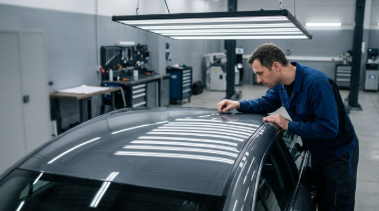
The final quality check using specialized lights reveals the true perfection of a repair.
By an auto body repair industry contributor.
The sound of a hailstorm ending is often replaced by a new worry. You walk outside and see it: dozens of dents across your car’s hood, roof, and trunk. The first question is always the same: what will this cost? The next question is harder: how does the insurance process even work?
Many drivers think a hail claim is a simple, one-step process. In reality, it involves a careful check of the damage, working with your insurer, and a special repair method called Paintless Dent Repair (PDR). This method gently pushes the metal back to its original shape. It doesn’t use any sanding, body filler, or new paint. Finding a specialist is key, as how well they do the job decides how your car will look. For example, the kind of focused service you’d find with a provider like StormWise Hail Repair Denver is very different from a general body shop.
Quick answer: For most drivers with full coverage, the only cost you pay is your insurance deductible. Your insurance company pays the full repair bill, which can be thousands of dollars. The whole process usually takes one to three weeks from start to finish.
What’s inside
- How do shops and insurers calculate hail damage costs?
- What separates a great hail repair shop from a mediocre one?
- What’s the step-by-step timeline for a repair?
- Frequently Asked Questions About Hail Repair
- The Bottom Line on Your Hail Repair
How do shops and insurers calculate hail damage costs?
The total cost is figured out using a standard price chart called a “dent matrix.” This chart sets prices based on how many dents are on each body panel and how big they are. It also adds the cost for any parts that have to be removed to reach the dents.
This isn’t just a guess. Insurance adjusters and repair shops both use special software with this price chart built in. The chart gives a dollar value to each panel on your car (hood, roof, fender, etc.). The price for each panel goes up based on two things: how many dents there are, and how big they are, usually dime, nickel, quarter, or half-dollar size. A hood with 20 nickel-sized dents will have a different repair price than a hood with 50 dime-sized dents. This system creates a fair starting point for every estimate.
Next, the shop adds the cost of labor to get to the dents. This is called “Remove and Install,” or R&I. To fix dents on a car’s roof, a mechanic has to remove the ceiling material (the headliner), side panels, and lights inside. Fixing a door panel often means removing the inside trim and the window. Each of these steps has a set labor time, and that cost is added to the bill.
Finally, the first estimate is almost never the final bill. When the car is cleaned and put under special lights in the shop, mechanics almost always find more dents than the adjuster saw outside. When this happens, the shop takes pictures of the extra damage and sends a “supplement” to the insurance company. This is a request for more money to fix the damage they just found.
❝ A supplement is a normal part of a good hail repair. The first insurance estimate is just a starting point. A shop that finds more damage and asks for a supplement is being careful, not trying to overcharge. Good notes and clear talks with your insurer are what matter.
The final cost your insurance company pays is the total of the first estimate, all the labor charges, and any approved supplements. The only money you pay is your deductible.
See also: Mutf_In: Sbi_Life_8to0lj
What separates a great hail repair shop from a mediocre one?
The difference is how well they do Paintless Dent Repair, how they handle insurance claims, and if they show you their work process clearly.
A quality repair is about more than just making dents disappear. It’s a skill that needs special training and tools. Look for mechanics who are certified by groups like Vale Training or PDR Nation. These aren’t easy online courses. They involve tough, hands-on tests to prove a mechanic can do great repairs on different kinds of metal and dents. A shop that pays for certified mechanics cares about quality.
The tools they use to check the work are as important as the tools they use to fix it. Ask a shop if they do their final check under a “light tunnel” or with a special board that reflects light. These lights show sharp, straight lines on the car’s body. This makes even the smallest mistake or bump easy to see. A repair might look perfect outside but show small flaws under these lights. A shop that uses them wants a perfect finish.
Finally, see how they talk about the insurance process. A good shop will work with your insurer on any supplements. They should be able to explain how they record extra damage and talk to the adjuster. According to the Federal Trade Commission, you should always get a written estimate and a clear explanation of the work before authorizing repairs. Be careful with shops that don’t want to put things in writing. Also, watch out if they talk a lot about “waiving” your deductible. This can be a sign they are cutting corners somewhere else.
❝ Ask this question: “If you find more damage than the first estimate, what is your process for filing a supplement?” A clear, detailed answer about taking photos and talking to the adjuster is a very good sign.
The best shops give a lifetime warranty, guarantee their repairs, and handle the whole insurance process for you.
| Signs of a Quality Shop | Potential Red Flags |
| Mechanics have PDR certifications (like Vale, PDR Nation). | Doesn’t give clear answers about training. |
| Uses special lights for the final check. | Only checks cars outside or in normal light. |
| Works with your insurer on supplements. | Asks you to talk to the insurer or pay more. |
| Gives a written estimate and lifetime warranty. | Only makes promises by talking or offers to “waive” the deductible. |
| Has a real, permanent shop. | Works from a tent or has no local address. |
What’s the step-by-step timeline for a repair?
A normal hail repair takes one to three weeks. It has five main steps: checking the damage, getting insurance approval, doing the repair, putting the car back together, and a final quality check.
The timeline is more than just fixing dents. It’s a process that needs careful paperwork and teamwork with your insurance company. Here’s what happens after you drop off your car.
- Taking Things Apart and Mapping Dents. First, mechanics take some parts of the car apart. They carefully remove inside parts like the ceiling cover (headliner), side trim, and sometimes door panels. This lets them reach the back of the damaged metal. It also lets them do a full damage check under special lights that show every single dent.
- Supplement and Approval. Once the shop knows all the damage, they record everything with photos and notes. They send this “supplement” to your insurance company. This is where delays often happen. The shop can’t continue the repair until the insurance company checks the proof and approves the extra costs.
❝ A delay while waiting for supplement approval doesn’t mean the shop is slow. It means they are being careful. Rushing a repair without full approval means the shop might cut corners, or you could get a surprise bill. The wait makes sure the job is done right and paid for by the insurance.
- Paintless Dent Repair (PDR). With the supplement approved, the PDR technicians begin their work. Using a combination of specialized metal rods and glue-pulling tools, they meticulously massage each dent from the inside out, restoring the panel to its original shape without harming the factory paint. This is a highly skilled craft that requires patience and precision.
- Reassembly and Quality Check. After all the dents are removed, the vehicle is carefully reassembled. Every panel, light, and piece of trim is put back in place. The car then undergoes a final, rigorous quality control inspection, often in a light tunnel that uses reflective lines to expose any remaining imperfections.
- Final Detailing and Pickup. The vehicle receives a final cleaning before you are contacted for pickup. The shop will walk you through the repairs and provide you with final paperwork, which should include a lifetime warranty on the work performed.
Frequently Asked Questions About Hail Repair
Will a hail damage claim raise my insurance rates? Typically, no. Hail damage falls under your comprehensive coverage, which handles “acts of God” or events outside your control. Unlike a collision claim where fault is determined, a hail claim is considered a no-fault incident. Filing one does not usually impact your future premiums or place you in a higher risk category with your insurer.
What happens if my vehicle is declared a “total loss”? A vehicle is considered a total loss when the estimated cost of repair exceeds a certain percentage of its actual cash value, often around 70% to 80%. If this happens, your insurance company will pay you the vehicle’s pre-damage value, minus your deductible. You then have the option to surrender the car to the insurer or, in some cases, keep the vehicle and a reduced payout. In many states the car will then carry a “salvage title,” although Colorado exempts vehicles totaled by hail alone.
Can I just keep the insurance check and not get the repairs? You can, but there are significant risks. If you have a loan on the vehicle, the check will likely be co-payable to your lienholder, who will require the repairs be completed. If you own the car outright and pocket the money, any future hail damage to those same panels will not be covered, as the insurer has already paid for that damage once.
Does Paintless Dent Repair work on aluminum panels? Yes, but it requires a higher level of skill and specialized tools. Aluminum is lighter and stronger than steel but has less “memory,” meaning it’s more difficult to massage back into its original shape without cracking or over-stretching. Technicians must be specifically trained to work with aluminum, which is increasingly common on hoods, liftgates, and fenders of modern vehicles.
How long do I have to file a hail claim after a storm? Most insurance policies require you to file a claim within a specific timeframe, which varies by policy. However, it is always best to act quickly. Waiting can make it harder to prove when the damage occurred, especially if another storm hits. Promptly filing a claim ensures the process moves smoothly and you get your vehicle restored sooner.
The Bottom Line on Your Hail Repair
Navigating a hail damage claim is less about fixing dents and more about managing a complex project. The most critical phase isn’t the physical repair, but the meticulous documentation and insurance communication that precedes it. A shop that immediately identifies more damage than the initial adjuster and files a supplement is not upselling you; they are performing the thorough assessment required for a complete repair. The pause while waiting for that supplement’s approval is the single most important part of the timeline. It ensures the job is funded correctly and that you are not left with unexpected costs or incomplete work.
Ultimately, your choice of a repair facility should hinge on their process, not just their price. Judge them by the clarity of their answers to questions about PDR certifications, final inspections under specialized lights, and their exact procedure for handling insurance supplements. A high-quality repair restores your vehicle’s value and appearance without compromise. A transparent, well-managed process ensures it happens without adding financial stress to an already frustrating situation.
About the author
StormWise Hail Repair is an automotive repair facility specializing in paintless dent repair (PDR) for hail-damaged vehicles in the Denver metro area. The company’s technicians manage the entire process for vehicle owners, from initial damage assessment and insurance claim coordination to the final repair and quality inspection. They focus on restoring vehicles to their pre-storm condition by handling the complexities of insurance supplements and approvals, ensuring a complete and documented restoration for every car they service.